Wednesday, July 8, 2009

Rose Flower Types and Meaning

Rose Flowers Meaning

Of all the different types of flowers available roses are the most popular due to their beauty and the significant rose flower meaning. There are many different colors of roses to choose from and all of them hold their own type of meaning. If you want to convey a particular message with the roses you send make sure you choose the right color for the occasion.


One issue to be aware of with rose flowers meaning is that they can be different from one culture to another. Make sure you take this into consideration when you are choosing what to send. You don't want your message to be misinterpreted.
Red rose flowers meaning is the one most of us are the most familiar with - love. The thorns are left on the flowers to represent that they love the two people share is stronger than any thorns that may cause pain in their relationship along the way. There are several different colors of red to choose from if you want to be very precise as to the rose flowers meaning each of them hold. Red roses are also acceptable to send to express feelings of sympathy.
Orange roses are a symbol of deep desire and feelings that you want to express to someone. They make a very bold statement if you are willing to take such a risk and send them. In other cultures orange rose flowers meaning says that you are proud of the accomplishments that the individual has made. Since these two meanings are quite different from each other you want to make sure they will be interpreted correctly.

Depending on the culture you live in yellow rose flowers meaning is quite different. For some it is a symbol of jealousy so they work well when you are trying to apologize for being jealous over something. The majority of people view yellow roses as a symbol of friendship and a deep bond. Still yet other cultures find yellow roses to be appropriate to send to express sympathy.
White roses are a great choice if you want to express your deep feelings for someone close to you. They symbolize a platonic relationship rather than a romantic one. They are also a symbol of purity and innocence. White rose flowers meaning makes it a common type of flower used for wedding decorations and wedding bouquets.
Pink rose flowers meaning expresses that you are thinking of the person. They are considered to be very elegant and classy as well. Pink roses are very sweet smelling and they can be sent any time instead of waiting for a special occasion. Blue roses are quite rare but they have a very powerful message - anything is possible. Black roses can also be sent to signify the sadness over a relationship ending or to express sympathy.

Roses are beautiful to look at and can be used to convey a variety of sentiments to someone. Everyone enjoys receiving roses of any color because there is often a great deal of passion and caring expressed with them. Roses are among the most expensive types of flowers to send to someone but they are well worth the cost to show someone just how much you care.

Types:

Roses are divided into several groups based on their parentage and when they were developed.

Modern Roses: Modern roses are defined as all rose groups that were developed after 1867. This was the year that the first hybrid tea was introduced. The most popular groups of modern roses are the hybrid teas, floribundas, and grandifloras. These roses are known for strong repeat blooming ability and for spectacular flower color and form. Other rose groups that are included in modern roses include the polyanthas, modern climbing roses, miniature roses, hybrid musks and modern shrub roses.

Hybrid Teas: These are the most popular roses, with long pointed buds, elegantly shaped flowers and usually one large bloom on a long cutting stem. The blooms are produced all season long and last well when cut. The flowers are most beautiful when half to three-quarters open. Hybrid teas are available in every color imaginable except for blue and black. Hybrid tea plants often have sparse foliage and tall, leggy stems that can reach 6 to 8 feet in height. These roses are grown for the glory of their flowers. They are not attractive as landscape plants.

Floribundas: These roses rebloom well in a wide range of bright colors. Floribundas are usually shorter and bushier than hybrid teas. The flowers are smaller and held in clusters but produced in great quantity. They are rarely fragrant but are very good as landscape shrubs.

Grandifloras: These roses are vigorous, and produce large beautiful blooms and pointed buds like Hybrid Teas with the hardiness and flower clusters of the shrubbier floribundas. Grandifloras generally are tall, slender plants.

Polyantha Roses: Polyanthas are small, compact bushes ranging from one to three feet in height, bearing large dense clusters of small blossoms. Polyantha roses rebloom prolifically. They make excellent subjects for containers, mixed borders and patio plantings.

Miniature Roses: Miniatures range in height from 8 to 24 inches and have small buds, stems, foliage and flowers. They are ideal for landscape borders, ground covers and potted indoor plants or hanging baskets. Miniature roses are a way to have a variety of blooms in a small space. They are grown on their own roots, so the suckers that come up are the same named variety.

Hybrid Musk Roses: Hybrid musks are large (5 to 6 feet or taller) shrubs of graceful, arching habit. They have attractive, leathery foliage and bloom in clusters of many small to medium-sized flowers. Most are highly fragrant, with fruity scents that carry a good distance. They have disease resistance and will grow in filtered shade.

Modern Shrub Roses: These roses are vigorous and hardy. They are attractive not only for their bloom, but also as landscape shrubs, with beautiful foliage, form and often bright stems and hips. Shrub roses are generally easier to maintain than other modern roses, requiring much less pruning. Many have good disease and pest resistance.

English Roses: English roses are a group of roses introduced in 1969 by the English rose hybridizer David Austin. They have the full flower form and fragrance of old roses but bloom repeatedly and come in more colors. English roses are often classed as shrub roses and many are good landscape plants. They are often billed as disease resistant but this is generally not the case in the South.

Climbing Roses: Climbers are vigorous growers that send out long shoots or canes which can be trained over fences, arbors or trellises. They are grouped into several types, with much overlapping among types.

Ramblers: This type of climbing rose blooms only once in late spring or early summer, with many clusters of small roses. Ramblers are very hardy and rapid-growing, as much as 20 feet in a season.

Large-Flowered Climbers: These climbers are slower-growing, are often trained on posts or some other type of support and may require heavy annual pruning. Many are sports (mutations) of shorter modern roses. Climbing hybrid teas do not bloom as continuously as do their bush parents, but flowers and foliage usually are identical.

Old Roses: Old roses include all rose groups developed before the introduction of the first hybrid tea rose. These plants are grown for their historic interest, color, fragrance and ability to survive adverse conditions. Old roses are divided into groups descended from European roses and those descended at least in part from Chinese roses.

European Roses: European roses are almost all spring bloomers that have one flush of bloom a year. Their colors are primarily whites, pinks, reds and purples. Many are extremely fragrant. They are quite cold hardy, but may not adapt well to hot areas. European roses include gallicas, damasks, albas, centifolias, and moss roses.

Gallica Roses: Gallicas are stocky, upright shrubs with fine prickles and deep green foliage. Some gallicas have simple single or semi-double blooms; others are very double, with swirled or intricately quartered petals. Many are highly fragrant. Flower colors are mainly deep pinks, crimsons and purples. Striped and mottled varieties are common.

Damask Roses: This is a very old group. They are taller plants than the gallica roses, with grayish-green foliage. Their habit is usually graceful and arching, spreading under the weight of many flowers. Damasks have large blossoms with a strong, distinctive fragrance. They range in color from white to deep pink. Damask roses are not adapted to the heat of the coast and lower Piedmont.

Damask Perpetual Roses: These are also called Portland roses. They were the only repeat-blooming roses until the introduction of the China roses. They are stocky, healthy bushes, with double, fragrant blossoms set in a ruff of leaves. The colors range from white through all the pinks to deepest red.

Alba Roses: Albas form tall shrubs with smooth stems arching up to 8 feet. They have few thorns. The albas have dense, bluish green foliage. They are very attractive garden plants, even when not in bloom. Their fragrant blossoms are generally white to blush pink. Albas are resistant to disease and grow into large, healthy shrubs. Albas are unusual shade-tolerant roses. They will grow in the open shade of a north-facing wall or under tall trees.

Centifolias: Centifolias are the ‘Cabbage Roses’. They are thorny, open bushes to 4 to 5 feet high. The very large, double and fragrant blossoms are borne so freely that they cause the plant’s branches to nod under their weight. Colors range from white to deep rose-red, sometimes striped and spotted.

Moss Roses: Mosses are sports of centifolia and damask roses. Their flower stalks and buds are covered with a mossy growth that exudes a balsam scent. Moss roses are susceptible to powdery mildew.

Chinese Roses: Chinese roses introduced reblooming ability to roses and quickly became very popular. In addition to reblooming ability, the roses included warm colors of yellow and scarlet. Although most were not cold hardy, they are beautiful plants, and well-adapted to heat. The rose groups descended from Chinese parentage include Chinas, Bourbons, Perpetuals, Noisettes and Teas. Many of these do well in the South.

China Roses: Chinas bear loose, semi-double flowers on graceful, wiry stems with red-tinted foliage. China roses are healthy plants, with compact growth. They rebloom throughout the growing season. Chinas range in color from deepest red and maroon through pink to white. Some hybrids also have warm tones of yellow, saffron, salmon and orange. They are rarely fragrant and are sensitive to cold, but most grow well in all of South Carolina except the mountains. Chinas are especially well-suited to growing near the coast.

Bourbon Roses: Bourbons are intensely fragrant. They grow into large shrubs exceeding six feet in all directions. They are susceptible to disease, but are grown for the beauty and fragrance of their prolific flowers and for their vigor. They range in color from deep reds through pinks to blush and white. Bourbons are well-suited to all areas of South Carolina, but will need extra care to control disease.

Noisette Roses: Noisettes originated in Charleston, South Carolina, during the first decade of the 19th century. They are tall shrubs or vigorous climbing roses with elegant, slender foliage. The flowers are in pastel colors including lovely soft yellows that are very rare in old roses. Noisettes are strong, healthy growers but not hardy in cold winters. Several cultivars will grow throughout South Carolina, while more tender sorts will do best on the coast. Noisettes are exceptional for repeat bloom, beauty of flowers and fragrance.

Tea Roses: Tea roses have exquisite, soft-colored blooms and excellent repeat bloom. Growth is slender and wiry like the Chinas. Their foliage is typically shiny and delicate. They have a unique tea scent. Teas are often tender, and not all will grow well in the colder parts of the state.

Hybrid Perpetuals: These roses will grow to be large, vigorous bushes if given good care. The large, fragrant flowers range in color from blush white to deepest red and purple. Many cultivars can be grown as pillar roses or short climbers. Hybrid perpetuals especially the dark red varieties, are susceptible to blackspot and powdery mildew.

Species Roses: Wild roses range from prostrate shrubs to enormous climbers. Their flowers range in color from white through all shades of pink to deep crimson. A few species are bright yellow. Species roses often have single blossoms and bloom once during the growing season. They are often very graceful landscape shrubs. Most are very hardy and disease-resistant. A few of the species roses that grow well in South Carolina include the Lady Banks roses, Cherokee rose and the sweet briar rose. Rugosa roses are a tough, disease-free group of roses that have repeat bloom and a wonderful spicy scent. They will grow best in the cooler part of the state.

There are innumerable cultivars of roses within all these groups. Consult a local rose grower or local chapters of the American Rose Society for recommendations on the best for your area.

Article from : http://www.momoy.com/2006/07/30/types-of-roses/

Tuesday, July 7, 2009

Cattleya Orchid

The Cattleya orchid is also called the “corsage orchid” because in the old days fashionable ladies used to sport an oversized Cattleya corsage to special events. Even though it is not so common to wear corsages anymore, the Cattleya orchid is still extremely popular among amateur and professional growers. They are perfect as cut flowers because they are long-lasting and come in an array of colors. The blooms are usually quite big; I’ve seen enormous Cattleya flowers that are as big as my face. (And I don’t have a small face by any standard!)

Bc Mini Purple 'Blue Hawaii'

The discovery of Cattleya was an accident. In the nineteenth century, a moss and lichen collector just grabbed some random sturdy leaves in the forest as packing material to protect his collections en route from Brazil to England. A horticulturist, William Cattley, saw the strange packing material and decided to grow it. Few years later, the strange plant produced some stunning blooms that rocked the world. The genus was therefore named Cattleya as a tribute to William Cattley, and the plant was then named Cattleya labiata. From then on, people started the crazy hunt for wild orchids in South America.

To this day, Cattleya orchids still define orchids; they are the benchmark of orchids. You may hear growers say “grow this orchid like Cattleya except a bit less light” or “this orchids need the Cattleya temperature.” Because Cattleya species are founded throughout tropical Central and South America, these orchids like intermediate to warm temperatures (55 to 65°F/13 to 18°C in winter nights and 15°F/10°C or so warmer during the day) and medium bright light. At home, it’s best to grow your Cattleya orchid by the southern, eastern or western windowsills. Provide as much light as it can take without burning the leaves; touch them to make sure they are not hot. When the plant receives its upper limit of light, it will show you a reddish tinge.

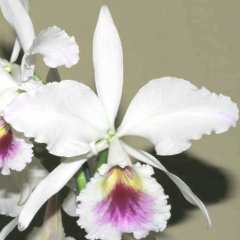
Cattleya labiata

Since Cattleya orchids are epiphytes, they like their potting material to dry out between watering. Or if you live in humid area, you can even mount your orchid on a slab of wood or on the tree in your garden. That way, you would never over water your plant!

American Orchid Society provides a good one-page free culture sheet on Cattleya, so you can print one out as a reference.

Cattleya Hybrids

The advantage of growing hybrids is that they can flower more than once a year. (Usually species can only flower once a year.) Breeders developed hybrids by breeding Cattleya orchids with related genera. For example:


Blc Port of Paradise

Cattleya x Laelia = Laeliocattleya (Lc.)
Cattleya x Epidendrum = Epidcattleya (Epc.)
Cattleya x Brassavola x Laelia = Brassolaeliacattleya (Blc.)

As you can see, the names are not super creative, because some orchid people are way too serious. They are just combing the genera together. But that way it is easy for us to understand what the makings are. When four or more genera are involved, people are forced to come up with more creative names like:


Iwanagaara Apple Blosom 'Fantastic'

Cattleya x Brassovola x Laelia x Sophronites = Potinara (Pot.)
Cattleya x Brassavola x Laelia x Dialaelia = Iwanagara (Iwan., short for I wanna grow ya!)

It is not very important to know these names, but if you happen to get a plant that has one of these abbreviations, then you know what they mean. The Cattleya hybrids require more or less similar growing conditions as the Cattleya species. But when you get into orchids a little more, you would know that, for example, Brassavola requires very bight light, so its hybrid with Cattleya also needs a bit more light.

Cattleya Species

Don’t limit yourself to grow just Cattleya hybrids. You should also try growing the species as they are equally


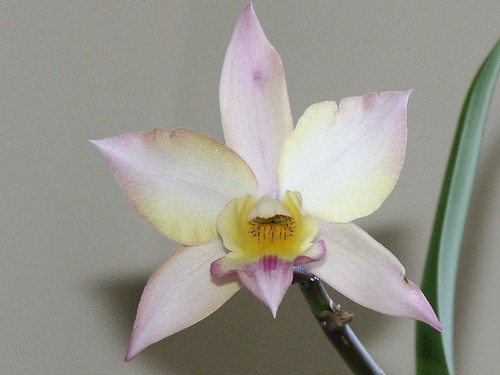
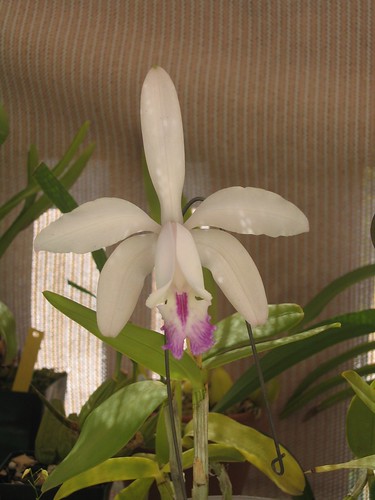
Cattleya intermedia

rewarding, if you can stretch your idea of equally rewarding to mean that they bloom half as much. My first recommendation is Cattleya intermedia. Mine faithfully blooms for me despite my neglecting it. They come in many different colors, such as pink and white. My Cattleya intermedia is white with a hint of blue, and the lip is partly reddish pink. These beauties are originally from Brazil, Uruguay and Paraguay.


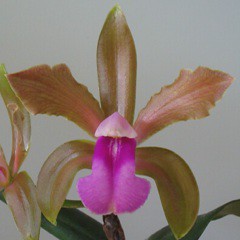
Cattleya bicolor

Another one you should try is Cattleya bicolor. I love that these flowers look so waxy that they don’t even look real. They are bifoliate (each bulb has two leaves instead of one) and can bear up to five 2.5 inch (10 centimeter) flowers. The pink, green and reddish-brown bloom can give you weeks of enjoyment.


Other Photos:


Cattleya Borneo

CattleyaOjai Verde

Cattleya Mayumi

Cattleya Kurt

Cymbidium Orchid

Green Cymbidium Orchid

A Cymbidium orchid is a great starter orchid to try your green thumb if you live in coastal California, New Zealand,Australia, South Africa or the Mediterranean. Originally from a higher altitude in Central and Southeast Asia, and all the way to Australia, the standard Cymbidium enjoys a cool climate and strong light with partial shaded conditions. But the smaller-flowered terrestrial and tropical species live in different environments, so even if you do not have perfect Southern California weather, you can still grow these beauties. Let me tell you a little bit more about the different types of Cymbidium.

Cymbidium has retained its status as a celebrity orchid for thousands of years since the time of ancient China. Why do people love them so much? Cymbidium orchid hybrids produce up to 30 flamboyant and sometimes fragrant blooms on a single spike, and the flowers last couple of months. The Cymbidium I received for my birthday (boyfriend, here’s your acknowledgment!) in January still looked pristine in April. But wait, there’s more! Even if you cut those spikes and put them in a vase, the flowers will last just as long. No wonder Cymbidium is one of the most popular orchids for corsages. And even though there are only 44 species, thousands of hybrids have been developed to satisfy people’s demand for variety.

Standard Cymbidium Orchid

“Standard” Cymbidium refers to the large-flowered species from the Himalayas and China. These well-loved plants produce large, attractive flowers that come in many different colors. The roundness of these flowers is a very desirable trait and commercial hybridizers work hard to develop plants that produce the fullest looking flowers. Even though they are tolerant of extreme temperatures, to thrive and to produce flowers, they require frost-free cool nights (below 53°F/12°C) and warms days. Cymbidium demands a little more fertilizer than most other orchids, so be sure to apply fertilizer twice a month at half the strength that is prescribed on the instruction label. You can also use the slow-release fertilizer once a year and forget about it for the rest of the year.American Orchid Society provides a good one-page free culture sheets on standard Cymbidium, so you can print one out as a reference.

Miniature and Compact Cymbidium Orchid

If your living environment does not accommodate a standard-sized Cymbidium, you should consider growing a miniature or a compact Cymbidium. As a bonus, the flowers of these orchids are as showy as those of standard Cymbidium (two to three inches/five to eight centimeter wide) but are easier to bloom because they do not require a substantial chilling period to produce flower spikes. These Cymbidium will only grow to one to three feet tall and they bear up-right flower spikes with often fragrant flowers. These terrestrial orchids will flourish in an intermediate temperature year round.

Cascading Cymbidium Orchid

Cascading Cymbidium has stolen the spotlight for quite a number of years now. They are very compact and produce smaller, yet profuse flowers. The cascading Cymbidium have pendent flower spikes that can reach up to 30 inches (76 centimeters) so you should grow them in hanging baskets or in a pot on a bench to maximize the stunning display. The flowers of the cascading Cymbidium could grow to be so dense that it totally covers the growing container. These floriferous (yes, that’s a real word) orchids do not require any chilling period; in fact, you should keep these tropical orchids continuously warm.

No matter which type of Cymbidium you are growing, keep in mind that these orchids like bright light (shaded from direct sun nonetheless). If your plant has weak and lifeless flower spikes and dark green leaves, it’s telling you that it needs more light. Also, at least once a month, flush the potting medium with fresh water with no fertilizer, so that the accumulated salt can be removed from the pot. If that is not done, you can see that the tips of the leaves will turn yellow and burnt.

Other photos:

Cymbidium Orchid (Evening Star)

Cymbidium Orchid (Coronet Peak)

Cymbidium Orchid


Find more here :

http://everything-orchids.com/cymbidium-orchid.html

Types of Orchids

There are over 25,000 types of orchids and, in fact the Orchidaceae family is the most numerous in the plant world! These beautiful plants have been around for over 100 million years and plants can range from microscopic to reaching several feet in height. The flowers have a distinctive look with 3 inner petals surrounded by 3 outer petals and a cupped petal that is distinct from the others. Some orchids even resemble other creatures like bees, moths and lizards!

Although we think of orchids as a tropical flower they can actually grow in almost any climate. They can grow on the ground or on trees and even rocks. Orchids are classified depending on their water requirements. Paphiopedilum, Cymbidium and Odontoglossum need a moist environment all year long.
Cattelya, Oncidium and Dendrobium only need water when they are actively growing and the vanda Ascocend doesn’t really need water at all.

Cymbidium orchids are some of the most popular having 40 species and thousands of hybrids. These are one of the oldest cultivated orchids and can grow on the ground, on trees or on rocks. They can be found growing naturally in Japan, China, South East Asia and Australia. These are one of the easiest orchids for beginners and will flower every year if cared for properly.

Perhaps the most exotic of all orchids is the Cattleya which hails from South America. These are the orchids most typically chosen for corsages, however they have been over collected and many of these types of orchids are now endangered.

The Denrobiums are the second largest orchid genus and have over a thousand species. These flowers can be found in Northern India, South East Asia, Australia and Polynesia. They typically grow near the equator in tropical conditions, although some grow in climates with dry winters. While these are easy to grow, it is rather difficult to get them to bloom regularly.

Phalaenopsis orchids have long lasting flower and are rather easy to grow. These flowers are favorites at weddings and can be colorful in pinks, yellows and stripes. These are native to the Philippines and are quickly becoming a popular house plant.

Vanda orchids are another plant that is rather easy to grow. These plants produce flowers in vibrant colors such as blue, red, yeloow and orange. Flower spikes can have as much as 10 blooms that last for several weeks.

Orchids are a bit finicky to grow but these delicate plants will reward you with a soothing fragrance and beautiful distinct flowers. When growing orchids in your home, you need to remember to give them enough light, enough water and proper temperatures and fertilization. Orchids will need to be repotted every 2 or 3 years.

The orchid family, Orchidaceae, is the most numerous in the plant kingdom. There are about 25,000 to 30,000 known species of orchids around the world. Orchids are found in all continents except Antarctica, from hot tropical jungles to the cold climate in North America. However, some orchids are found only in certain region of the world and nowhere else, for example, the Vanda genus colonizes only South East Asia.

There are two types of orchids: terrestrial orchids and epiphytes. Terrestrial orchids, such as Cymbidium, grow on the ground, while epiphytes establish themselves on trees. Each type of orchids can grow in two different ways:

* Sympodial orchids: the new shoots emerge alongside of the old plants, causing lateral spread. Catleya is sympodial-epiphytes. Most epiphytic- sympodial orchids have storage stems, pseudobulbs or bulbs, to help them survive the dry season.
* Monopodial orchids: new growth is added to the apex, increasing the plant's height. The leaves are arranged alternately around the stem. Examples of monopodial orchids are Vanda, Phalaenopsis...

Most popular orchids grown today are hybrid species, creating by plant breeders in their hundreds of thousands. These "new" species may be the result of crossing two related species, or from three to four different genera.

Orchids are the most beautiful, the most sensual, the most exotic, and the most costly flowers. But you can enjoy them free at this site. If you want to know more about orchids, please visit The American Orchid Society and The Orchid Lady.


More on orchids and its hybrids visit this site :
http://www.flowerpictures.net/orchids/index.htm

Red Flowers Collection

  Lots of varieties of red flowers you must know that captivate your eyes. So lovely 27 red flowers! Roses There are over 150 species of ros...